

Lawn Care Services near Me Prices: What to Expect to Pay
Lawn care services near me prices are the rates local providers charge for recurring and seasonal yard work. For most U.S. homes, a mowing visit runs about $42 to $68. Other services are priced per job. Weed control starts around $50, aeration around $107, and a leaf cleanup can reach $435. Your own number depends on lawn size, grass type, how often you book and how overgrown the yard is.
This guide shows you how to turn those national ranges into a realistic budget for your own property. You will see why knowing prices matters, how to estimate a full season with a worked example, what pushes a quote up or down, how to compare bids side by side, and where you can save without cutting corners.
We wrote it from the point of view of a working lawn care company. Sparta Lawn Care is veteran-owned and locally owned, with more than 20 years of experience serving Columbia, Blythewood, Elgin and the wider Midlands. The examples lean toward warm-season lawns in South Carolina. Treat any published range as a yardstick. The price that counts is the one you get in writing for your property.
Why knowing local lawn care prices matters
Knowing typical prices lets you set a budget before you call anyone and judge a quote in a minute instead of guessing. Lawn care spans a huge spread, from a $42 mow to a sod installation that can top $3,000, so a benchmark is the only way to tell what is normal.
It turns a vague budget into a number
Most homeowners buy lawn care in three layers. Recurring work, mostly mowing and trimming, is your steady cost through the growing season . Seasonal services such as aeration, fertilizing and leaf removal are priced per visit or per job . One-time projects like seeding, sod or tree work are the big, occasional expenses.
- Recurring: mowing at about $42 to $68 per visit
- Seasonal: aeration at about $107 to $202 per job
- Projects: professional seeding at about $427 to $1,514
Across the country, an average monthly lawn care bill falls between $100 and $410. That is a handy sanity check once you have added up your own list.
It protects you from overpriced and underpriced bids
Overpriced bids are the obvious risk. If a standard mow on a typical lot comes in far above the national range, ask what is included and how the lawn was measured. A good provider can explain every line.
Underpriced bids cost you in a different way. A $25 cut can mean a very small lawn, a rushed job, or an operator without insurance. That can leave you exposed if a worker is hurt or a rock breaks a window. The cheapest bid is not always the lowest total cost , especially when you pay twice to repair a scalped lawn.
A fair price is one the provider can explain line by line, not just the lowest number on the page.
What counts as a lawn care service
"Lawn care" is a bundle, and quotes only compare when the bundles match. Here is how the work usually breaks down:
- Mowing and trimming: cutting, string trimming, edging and blowing off hard surfaces
- Treatments: fertilization and weed control
- Turf renewal: aeration and overseeding
- Seasonal cleanups: spring cleanup, fall cleanup and leaf removal
- Pruning: shrubs, plants and trees
- Projects: sod, seeding, mulch and sprinkler work
How to estimate what you should pay
Measure your lawn, list the services you want, match each one to a typical range, and add up a season. This takes about 15 minutes and gives you a number to hold every quote against.
Measure your lawn and list the services
Start with square footage, because nearly every price scales with it. Measure only the turf, not the driveway or beds. Multiply length by width in feet, so a 50 by 30 foot lawn is 1,500 square feet. For irregular shapes, measure each section and add the results together .
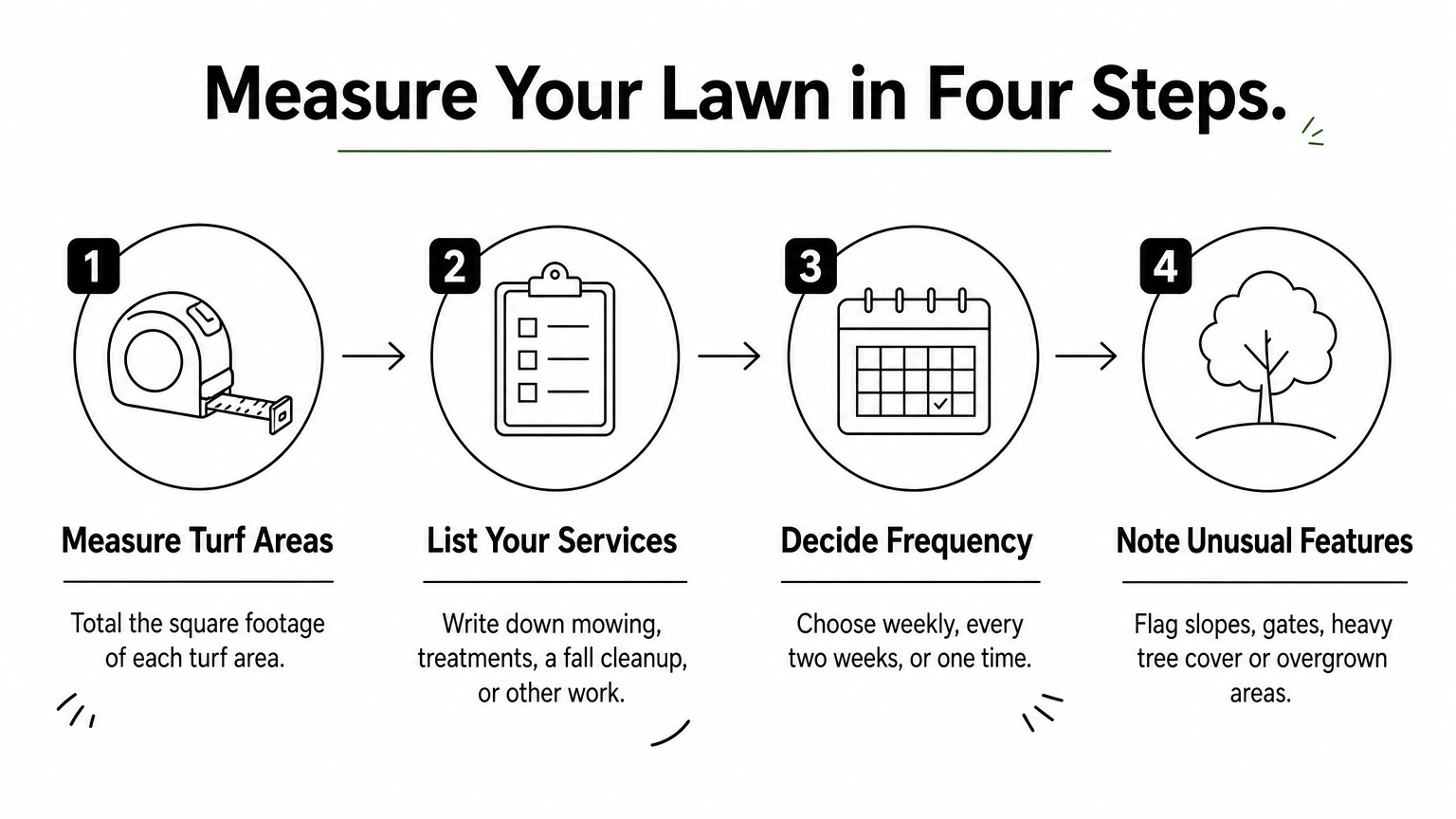
- Measure each turf area and total the square footage.
- Write down the services you want, such as mowing, treatments or a fall cleanup.
- Decide on frequency: weekly, every two weeks, or one time.
- Note anything unusual, like slopes, gates, heavy tree cover or overgrown areas.
For reference, the national average lawn is about 8,712 square feet, or one-fifth of an acre. If yours is far smaller or larger, expect to land near the low or high end of every range below.
Typical prices by service
These are national ranges for common services. They show the order of magnitude, not a quote for your yard.
| Service | Typical national price |
|---|---|
| Mowing | $42 to $68 per visit |
| Weed control | $50 to $210 |
| Fertilization | $67 to $405 per treatment |
| Dethatching | $65 to $165 |
| Aeration | $107 to $202 (average $154) |
| Leaf removal | $107 to $435 |
| Yard cleanup | $216 to $462 |
| Seeding | $427 to $1,514 |
| Mulch, installed | $192 to $402 per cubic yard |
| Bush trimming | About $46 per bush |
| Tree trimming | $430 to $640 per tree |
Other national price guides land in the same neighborhood for mowing, with most visits between $30 and $80. Costs in the Midlands can sit above or below these figures , so use the table to spot quotes that are wildly off, then let local bids set the real number.
Hourly rates for short jobs
Some providers bill by the hour, especially for cleanups, overgrown yards or odd jobs. Nationally, mowing runs about $32 to $68 per hour and hand weeding about $35 to $105 per hour. That answers common questions about what two hours of yard work or three hours of mowing should cost:
| Job | Hours | Typical total |
|---|---|---|
| Mowing | 2 | $64 to $136 |
| Mowing | 3 | $96 to $204 |
| Hand weeding | 2 | $70 to $210 |
Hourly pricing suits uneven work. For a standard lawn on a schedule, a flat per-visit price is clearer and easier to compare.
A worked example for an average lawn
Take an average 8,712 square foot lawn. Assume weekly mowing for 30 weeks, which is a reasonable stand-in for spring through early fall on warm-season grass. Add one aeration and one fall leaf cleanup.
| Item | Low | High |
|---|---|---|
| Weekly mowing, 30 visits | $1,260 | $2,040 |
| One aeration | $107 | $202 |
| One leaf cleanup | $107 | $435 |
| Season total | $1,474 | $2,677 |
Spread over 12 months, that is about $123 to $223 a month, which sits inside the national monthly range of $100 to $410. Fertilization and weed control come on top, at roughly $67 to $405 and $50 to $210 per treatment. Ask any provider how many applications their program includes.
Add up a season, not a single visit, and the number you compare quotes against becomes far more honest.
What drives lawn care prices up or down
Lawn size sets the baseline, and condition, grass type, frequency and site access move it from there. Providers also differ in how they bill, which can make identical work look different on paper.
Lawn size, condition and obstacles
Bigger lawns cost more because they take more crew time, so nearly every provider prices by square footage in some form. A yard well above the 8,712 square foot average will sit at the top of each range. Slopes, narrow gates, tree roots, stumps and tight beds slow the crew down and raise the bid.
Condition matters as much as size. A lawn left uncut for several weeks takes longer and often carries an overgrowth surcharge. Neglect also creates corrective work, like extra weed control or dethatching at $65 to $165. Regular care keeps every later visit cheaper .
Grass type and the Midlands growing season
Grass type shapes both the work and the calendar. Around Columbia, lawns are mostly warm-season turf such as Bermuda, Zoysia and Centipede. Bermuda grows fast in summer heat and often needs weekly cuts. Zoysia is dense and tough on mower blades. Centipede grows slowly and wants a lighter hand with fertilizer.
These grasses go dormant once cold weather settles in, so mowing here is seasonal rather than year-round. Your annual mowing bill covers roughly spring through early fall. A good fertilization and weed control program is matched to grass type, soil health and season , not run on one fixed schedule. Local demand, soil and cost of living also shift prices, which is why national ranges can miss in either direction.
Frequency and how providers charge
How a provider bills changes how a quote reads. Four models cover most of what you will see:
| Model | How it works | Fits best |
|---|---|---|
| Per visit | Flat price each mow | Standard lawns on a regular schedule |
| Hourly | Time on site multiplied by a rate | Cleanups, overgrown or uneven jobs |
| Monthly plan | Fixed amount with services bundled | Budgeting for mowing plus treatments |
| Per project | One price for the whole job, sometimes per square foot | Seeding, sod, tree work, large cleanups |
Frequency matters too. Recurring customers usually pay less per service than one-time customers, because the provider can plan routes and crew time. Weekly service during peak growth also keeps grass short, so each visit goes faster than a cut on a lawn that got away from you.
Two quotes can describe the same work and still look different, so convert both to a season total before you compare.
How to compare quotes and spot a fair one
A fair quote is written, itemized, covers the same scope as the others, and falls near the typical range for your lawn size. Get at least three, and make sure each provider is pricing the same job.
Ask every provider for the same scope
Different scopes are the main reason quotes look incomparable. Send each provider the same details. Copy this request and fill in the brackets:
 Hello, I'd like a written quote for my property.

Address: [your address]
Approximate lawn size: [square feet]
Grass type: [Bermuda, Zoysia, Centipede, or not sure]
Services wanted: [mowing, trimming, edging, blowing, other]
Frequency: [weekly, every two weeks, one time]
Notes: [slopes, gates, pets, overgrown areas]

Please list what is included in each price, how you bill (per visit or monthly), whether you are licensed and insured, and how I pay.
What a basic mowing visit should include
Before you compare, confirm what a standard visit covers. If one bid leaves out trimming or cleanup, it is not a like-for-like price . A complete visit includes:
- Mowing at a height suited to your grass, without removing more than one-third of the blade at a time
- String trimming around trees, fences and other obstacles
- Edging along sidewalks and driveways
- Blowing clippings off hard surfaces
Checks beyond the price
Verify that the company is licensed and insured , and ask for the scope in writing. Find out how you pay, whether the same crew comes each visit, and what happens if you are unhappy. These details tell you more about the real cost than the headline number does. Watch for these red flags:
- A price far below every other bid, with no explanation
- No proof of insurance
- A large deposit demanded before any work
- Vague terms such as "full service" with nothing itemized
Here is how that looks in practice. At Sparta Lawn Care, the same familiar crew serves each property, and clean trucks, equipment and personnel come with the job. We are licensed and insured. Payment is by credit card through a secure online client hub. If a customer is unhappy, we come back and fix the service at no additional cost until it is right. Whoever you hire, ask each company for its equivalents.
The right quote is the one that spells out scope, insurance and what happens if the work falls short.
How to lower your lawn care bill without cutting corners
The most reliable savings come from recurring service, bundled work, well-timed seasonal jobs and keeping the lawn from getting out of hand. Chasing the lowest per-cut price rarely saves as much as these habits do.
Book recurring service and bundle jobs
Regular service almost always costs less per visit than one-off calls. Many providers also offer packaged plans, such as mowing, fertilizing and aeration together, at a lower combined price than buying each separately. Think of it as buying lawn care in bulk . Ask whether a plan locks in your rate for the season and whether skipped weeks during dormancy are handled fairly.
Time seasonal work right
Doing a job at the right time prevents repeat visits and corrective work. Here is the timing we recommend for the Midlands:
| Service | Best timing |
|---|---|
| Fall cleanup and leaf removal | Late fall, after most leaves have dropped but before colder temperatures set in |
| Overseeding, paired with aeration | Fall |
| Tree and shrub trimming | Late winter to early spring for most trees and shrubs |
| Spring cleanup | Spring: leaf and branch removal, bed cleanup, light pruning |
A leaf cleanup booked too early can mean a second pass after more leaves fall. Pruning at the right time also keeps plants healthier and can reduce storm-related breakage near structures.
Cheap, $25 and free options
A $25 cut is possible for a very small lawn, but it sits below the roughly $30 floor that national guides cite for basic mowing. Check that the provider is insured and that the price covers trimming and cleanup. Budget-friendly is not the same as bargain-basement . A modest, reliable price on a fixed schedule usually beats a rock-bottom bid that gets dropped mid-season.
Free help is rarer. Some communities have volunteer or senior assistance programs, and your local Area Agency on Aging is a reasonable place to ask. Doing the work yourself is the other route. It only saves money if you already own a mower and trimmer. Without them, equipment, maintenance and storage can cost more over time than hiring a pro.
Savings come from planning and timing, so the cheapest cut is usually not the cheapest lawn.
Setting a fair lawn care budget
Fair lawn care pricing comes down to a few things you can check yourself. Know your square footage, price a full season instead of one visit, and compare itemized quotes that cover the same work. Use national ranges to spot outliers, then trust the written bid for your property. Time the seasonal jobs well and the total tends to stay predictable.
If you want a number for your Midlands lawn, request a quote from Sparta Lawn Care. You can also call or text (803) 261-1485. Tell us your lawn size, grass type and the services you want.